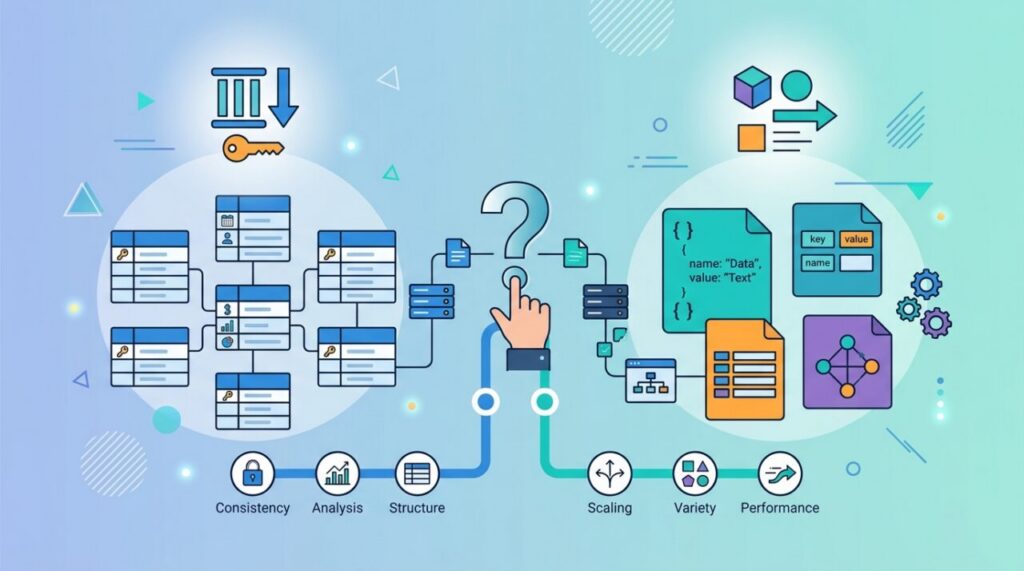

One of the first big decisions in any new project is where your data will live — and that usually comes down to the classic question of SQL vs NoSQL. It’s a choice that shapes how you build, scale, and reason about your application for years. The internet is full of tribal arguments about which is “better,” but the honest answer is that they solve different problems. Here’s how to actually choose.
What SQL databases are
SQL (relational) databases like PostgreSQL, MySQL, and SQLite have been the backbone of software for decades. They store data in tables with rows and columns, and — crucially — with a predefined schema that says exactly what shape your data must take. Tables relate to each other through keys, so a customer can be linked to their orders, and each order to its items.
Their defining strength is structure and consistency. They’re queried with SQL, a mature and powerful language, and they offer strong guarantees (summarized as ACID) that keep your data reliable even when many operations happen at once — which is why they dominate anywhere correctness really matters, like finance.
What NoSQL databases are
“NoSQL” is an umbrella term for databases that don’t use the traditional relational table model. It covers several families:
- Document stores (like MongoDB) — data lives in flexible, JSON-like documents.
- Key-value stores (like Redis) — dead-simple, lightning-fast lookups by key.
- Wide-column stores (like Cassandra) — built for massive scale across many servers.
- Graph databases (like Neo4j) — designed for richly connected data like social networks.
Their common thread is flexibility. Most NoSQL databases are schema-less, meaning you can store records of different shapes without declaring a structure up front, and many are designed to scale horizontally across lots of machines with ease.
The core trade-off: structure vs flexibility
Here’s the heart of the SQL vs NoSQL decision. SQL gives you a rigid schema, which is a feature, not a bug: it enforces data integrity and prevents malformed records from sneaking in. NoSQL gives you a flexible schema, which lets you move fast and store evolving or varied data — at the cost of the database no longer guarding structure for you (your application code has to).
Neither is universally better. A rigid schema is a safety rail; a flexible one is freedom. Which you want depends on how well-defined and interconnected your data is.
How to actually choose
Lean toward SQL when:
- Your data is structured and relational — entities that clearly connect (users, orders, products).
- Data integrity and consistency are critical (payments, bookings, inventory).
- You’ll run complex queries joining data across many tables.
Lean toward NoSQL when:
- Your data is unstructured, varied, or rapidly evolving.
- You need to scale to enormous volumes of reads/writes across many servers.
- Your access patterns are simple and known — like fetching a document or value by its key.
A myth worth busting
You’ll often hear “SQL doesn’t scale” and “NoSQL is faster.” Both are oversimplified. Modern relational databases scale to enormous workloads, and a poorly designed NoSQL setup can be slower than a well-tuned SQL one. Performance comes from matching the database to your access patterns and designing well — not from the label on the box. Choose based on your data’s shape and your app’s needs, not on benchmarks ripped from context.
You don’t have to pick just one
Plenty of real systems use both. A single application might keep its core transactional data (users, orders) in PostgreSQL while using Redis for caching and sessions, and a document store for flexible content. This is called polyglot persistence: use the right database for each job rather than forcing everything into one. For most projects, though, starting with a solid relational database is a safe, well-understood default until you have a concrete reason to reach for something else.
A concrete scenario: modeling a blog both ways
Abstract trade-offs click better with an example. Imagine building a blog platform with users, posts, and comments.
In SQL, you’d create three tables — users, posts, comments — each row linking to its parent by ID. Fetching a post page means joining the post with its author and its comments (and each comment’s author). The database guarantees a comment can’t exist without its post, and a query like “top ten commenters this month across all posts” is a straightforward aggregate.
In a document store, you might embed comments directly inside each post document, with the author’s name denormalized (copied) into it. Fetching a post page is now a single read — no joins, very fast. But when a user renames themselves, their name is stale inside every post they ever commented on, and you must write the code that updates all those copies. And that “top commenters” analytics query? Much more awkward across embedded documents.
Neither model is wrong. The document version reads faster and matches how the data is displayed; the relational version keeps every fact in one place and answers arbitrary questions easily. That, in miniature, is the entire SQL-vs-NoSQL decision: optimize for how you’ll read, or optimize for consistency of facts.
Questions to ask before you decide
Rather than debating philosophy, answer these concretely for your project:
- Do my entities reference each other a lot? Orders that reference users, products, and payments — relational. Mostly self-contained records — documents work fine.
- Will I ask questions I haven’t planned for yet? SQL’s ad-hoc query power shines for analytics and reporting. NoSQL prefers you to know your access patterns up front.
- How bad is a consistency slip? A duplicated payment is a disaster; a briefly-stale like counter is nothing. Answer this honestly for your domain.
- What does my team actually know? A well-run PostgreSQL beats a poorly-run anything. Operational familiarity is a legitimate technical argument.
- What scale am I really at? Be honest — most applications never approach the scale where SQL becomes the bottleneck. Don’t architect for a billion users you don’t have.
Frequently asked questions
Is NoSQL faster than SQL? For the specific access patterns it’s designed around — key lookups, document reads — often yes. For complex queries, joins, and aggregations, a relational database with good indexes usually wins. “Faster” only means something relative to a workload.
Can a SQL database store JSON? Yes — and this changes the calculus for many projects. PostgreSQL’s JSONB columns let you keep flexible, schema-less blobs inside a relational database, querying and indexing them efficiently. If you mostly need structure with a little flexibility, that hybrid often beats adopting a whole second database.
What should a beginner learn first? SQL, without hesitation. It’s older than most programming languages in daily use, transfers across every relational database, appears in almost every backend job posting, and the concepts (schemas, joins, transactions) make you better at data modeling everywhere — including in NoSQL systems.
The takeaway
The SQL vs NoSQL question isn’t about which technology wins — it’s about matching the tool to your data. Choose SQL for structured, relational, integrity-critical data and rich queries; choose NoSQL for flexible, massive-scale, or simply-accessed data. Understand the structure-versus-flexibility trade-off at the center of the decision, and you’ll pick confidently instead of following whichever camp shouted loudest.