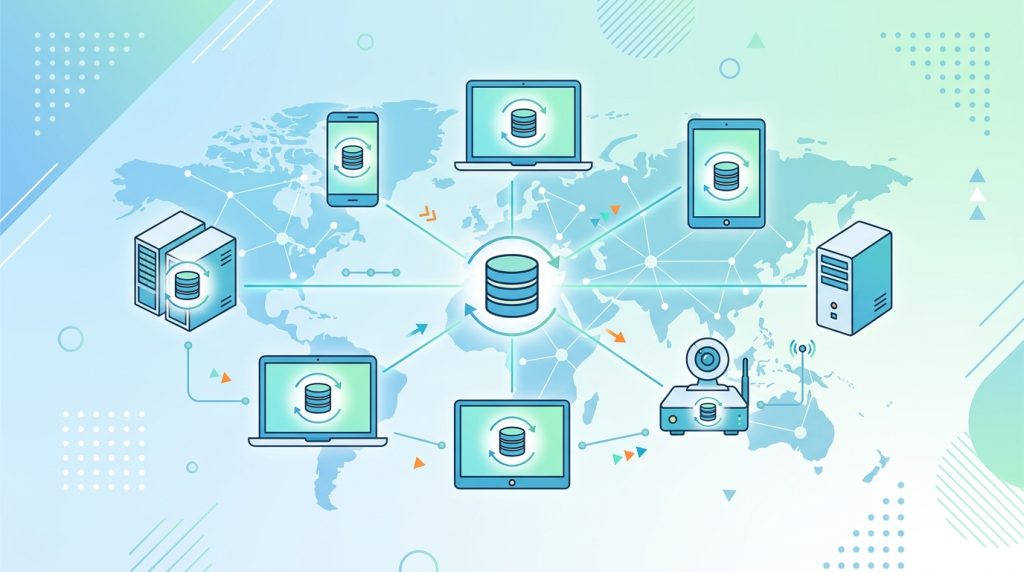

For most of its life, SQLite was thought of as “the little database” — great for phones and desktop apps, not something you’d run a real web backend on. That reputation is now badly out of date. SQLite at the edge has become one of the most interesting shifts in backend architecture, and it’s worth understanding why so many teams are suddenly reaching for it.
The old assumption, and why it broke
The conventional wisdom was that serious apps need a client-server database like Postgres or MySQL, with your web servers talking to it over the network. That network hop is the catch: every query pays a round-trip, and if your database lives in one region while your users are scattered across the globe, that latency adds up on every single request.
SQLite flips the model. It’s an embedded database — it runs inside your application process and reads from a local file. A query isn’t a network call; it’s a function call. There’s no connection pool, no separate server to operate, and no round-trip latency. For read-heavy workloads, that is astonishingly fast.
Why “at the edge” changes everything
Edge platforms run your code in dozens of locations close to your users. Pair that with an embedded database and something clever becomes possible: put a copy of the data in every location. Now a user in Tokyo and a user in London both hit a database that’s physically near them, reading at local-disk speed instead of crossing an ocean to a single central server.
This is exactly what projects like Turso and libSQL (a fork of SQLite built for this) enable — replicating a SQLite database to the edge and keeping the copies in sync, so reads are local and fast everywhere.
The honest trade-offs
SQLite isn’t magic, and it isn’t right for everything. The main consideration is writes. SQLite handles one writer at a time, so it shines for read-heavy applications — blogs, docs sites, dashboards, content platforms — far more than for write-heavy, high-contention systems like a busy payments ledger. The edge-replication tools soften this by routing writes to a primary and fanning reads out to replicas, but it’s the key thing to reason about before you commit.
Where it genuinely shines
If your app reads far more than it writes — and most apps do — SQLite at the edge offers a combination that’s hard to beat: near-zero read latency worldwide, dramatically simpler operations (it’s a file, not a server to babysit), and real cost savings. A surprising number of production apps that reflexively reached for Postgres would have been simpler and faster on this model.
The takeaway
The rise of SQLite at the edge is a reminder that the “obvious” architecture isn’t always the right one. An embedded database replicated close to your users turns database latency from a constant tax into a non-issue for reads. It won’t replace Postgres for every workload, but for the read-heavy majority, it’s a genuinely compelling default worth evaluating on your next project.